¶ Configure and use a stacked column visualization in DESK
Dashboards Classic
To visualize your query results as a stacked column chart, select Stacked column from the list above the query definition, in the upper-left corner of the page.
Use your metric selection to control which metrics are stacked.
Note that you can only stack metrics with the same unit.
¶ Example in Data Explorer

¶ Change visualization
When switching between visualizations, be aware that some visualization settings are visualization-specific.
- If you select a visualization and configure Settings for that visualization, and then you switch to a different visualization, some of your settings for the first visualization may be ignored because they don't apply to the newly selected visualization. An information icon in the list of visualizations will alert you to the possibility.

- If you switch back to the original visualization, you may need to reconfigure some visualization settings.
¶ Change metric selection
Your visualization can show any selection of metrics in a multi-metric query.
To toggle metrics on and off, you can select the letter next to the metric you want to visualize, or you can select the eye icon .

¶ Settings
The Settings section is one of the expandable sections in the right panel of Data Explorer. The contents of the Settings section may vary depending on the visualization you have selected.
¶ Resolution
Resolution is the X axis (time) granularity of the visualization.
- To allow Data Explorer to automatically select an appropriate resolution for the selected timeframe, in the Settings section, set Resolution to Auto
- To specify a certain resolution, select one from the list
Some resolutions are unavailable for some timeframes. If you select an incompatible combination of timeframe and resolution, DESK automatically selects a resolution and displays an explanatory message such as: Auto-resolution applied. Resolution value of [6 hours] applied. Selected timeframe doesn't allow for [5 minutes] resolution. To override auto-resolution, select a different resolution from the list.
Smart resolution on dashboard tiles
To prevent performance issues on dashboard tiles created with Data Explorer, the maximum number of data points for a query on a dashboard tile is 4,000. Based on the selected timeframe and the applied custom resolution, DESK projects the number of data points for the query result. If the projected number of data points exceeds 4,000, DESK automatically switches to a resolution high enough to keep the number of data points below 4,000.
Note that this does not apply to visualizations in Data Explorer itself, where you can have more than 4,000 data points. It applies only to dashboard tiles created with Data Explorer where the resolution/timeframe combination selected on the dashboard results in more than 4,000 data points.
¶ Show legend
Whether to display a legend under the visualization.
Note that the legend is active: you can select a legend entry to toggle display of the corresponding entry on or off.
¶ Connect gaps
To connect gaps in a chart, in the Settings section, turn on Connect gaps.
¶ Settings per metric
The Settings section also displays visualization options per metric selected for the query.
¶ Rename a metric
You can change the name of a metric as it is displayed on the chart and in the chart legend. The query definition retains the metric's original name.
- In the Settings section, select for the metric you want to rename.
- Edit the name, and then select the checkmark to save the new name.
¶ Change chart mode
To change the chart mode for a metric, in the Settings section, select a new chart mode from the list.
¶ Change color palette
To change the color palette for a metric, in the Settings section, select a new palette from the list.

¶ Unit and Format
Use the Unit and Format settings to determine how your data is displayed. If you export to a CSV file, the Unit and Format settings are also reflected in the exported values.
¶ Unit
Use the Unit setting to set the unit in which the metric is displayed.
- None = No unit displayed
- Auto = DESK selects an appropriate display unit
- Other selections specify the exact unit to display. The options here depend on the metric's unit. A time metric, for example, offers alternative units for displaying time.
- To add a custom unit/suffix string, type the custom string in the Unit box and then select it from the list.
- In Advanced mode, you can use :setUnit
(<unit>)to select from a wider range of units.
Examples of order-of-magnitude notation in DESK:
| Notation | Factor | Meaning |
|---|---|---|
| k | 10^3 | kilo, thousand |
| M | 10^6 | mega, million |
| G | 10^9 | giga, billion |
| T | 10^12 | tera, trillion |
¶ Format
Use the Format setting to configure the number of decimal places displayed for the selected metric.
None = No formatting.
Auto = DESK
selects an appropriate format. For example, where None would display 5.062357754177517 %, Auto would display 5.06 %.
Other selections specify the number of decimal places to display: 0, 0.0, 0.00, 0.000
¶ Examples
¶ Example: bytes
When the basic unit of the metric is bytes:
If you set Unit to Auto, DESK automatically expresses the results in a human-readable unit, which in this case could be GiB.
A byte-based unit can have either a binary or decimal base, which will determine whether DESK selects, for example, GiB or GB. If no base is defined in the metric itself, a decimal base is used.
-
If the automatically selected unit isn't suitable in your case, you can force DESK to express the same values in a specific unit (Unit = B, KiB, MiB, or GiB).
-
If you want to see raw data (no conversion), you can set Unit to None and see the results in the basic unit of the metric (which in this case is bytes).
¶ Example: dollars and cents
When the basic unit of a metric is dollars and cents:
- For smaller values, to see the results expressed in exact dollars and cents: set Unit to Auto, and set Format to 0.00 (to have two decimal places for the cents).
- For larger values, to see the results expressed in thousands, millions, or billions of dollars and no cents: set Unit to k (thousand), M (million), G (billion), and set Format to 0 (to see nothing after the decimal point).
¶ Example: exact counts
When the basic unit for the metric is a count:
-
To see an exact count:
-
Set Unit to Auto
-
Set Format to None
-
To see a rough count:
-
Set Unit to k (thousand), M (million), G (billion), or T (trillion), depending on the magnitude of your values
-
Set Format to 0.0, 0.00, or 0.0000, depending on how many decimal places make sense in combination with the selected Unit setting
¶ Example: thresholds
When setting threshold values:
If you select a Unit (for example, MiB), the Threshold settings are then prepared to match the selected unit, so you just need to enter threshold values without specifying MiB.
If you set Unit to Auto (to let DESK automatically scale the displayed output), you still need to set Threshold values in a specific unit such as bytes.
¶ Add color override
To force a different color (override the color palette) for a specific series such as a selected host
- In the Settings section, select Add color override
- Select the series from the list
- Select the override color for that series
¶ Axes
The Axes section is one of the expandable sections in the right panel of Data Explorer. In the Axes section, you can control how the X axis and each Y axis of your visualization are displayed.

¶ Name an axis
To name an axis
- In the Axes section, find the axis you want to rename.
- Select next to the axis name.
- Enter a new name and select the checkmark to save the change.
- The axis name is displayed vertically next to a Y axis and horizontally under the X axis.
¶ Hide or show an axis
To hide an axis
- In the Axes section, find the axis you want to hide.
- Select .
- To unhide the axis, select again.
¶ Define an axis position
To specify the side of the chart on which to display a Y axis
- In the Axes section, find the Y axis you want to move.
- Set Position to Left or Right.
¶ Set an axis minimum and maximum
By default, minimum and maximum axis values are set automatically.
To set custom minimum and maximum values for an axis
- In the Axes section, find the axis for which you want to define a minimum and maximum.
- Change the value of Min, Max from Auto, Auto to a comma-separated pair of values corresponding to the values on the selected axis.
¶ Threshold
The Threshold section is one of the expandable sections in the right panel of Data Explorer. The contents of this section may vary depending on the visualization you have selected. Use threshold settings to enhance your visualizations and tiles.

Set threshold values after you set Unit:
If you set Unit first, the threshold settings are prepared to match the selected unit.
If you change Unit after you set threshold values, the threshold values are not automatically adjusted to match the new unit setting.
¶ Set thresholds
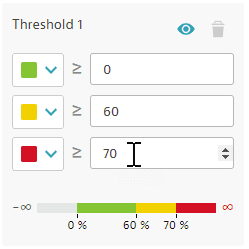
In the Thresholds section, enter threshold values
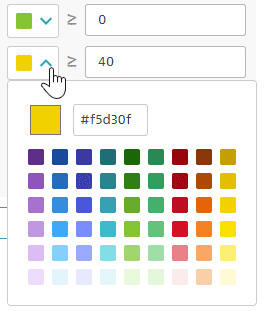
Adjust threshold colors optional
¶ Hide or show threshold colors
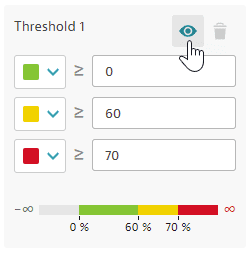
To hide or show threshold colors without deleting the threshold settings, in the Thresholds section, select .